Nunchi Meaning: The Korean Art of Reading the Room
What is the nunchi meaning? 눈치 (nun-chi) is the Korean skill of reading the room: noticing how people feel, what they want and what the mood is, without anyone saying it out loud. Someone with good nunchi knows when to talk, when to stay quiet and when to change the subject.
In this post, we’ll explain what 눈치 really means, why it matters so much in Korea, the everyday expressions built on it, the famous nunchi game and why K-pop idols might have the best nunchi of anyone.
What Does 눈치 Mean?
눈 (nun) means “eye,” and Korean-American author Euny Hong translated 눈치 as “eye measure” in her 2019 book The Power of Nunchi. It’s the ability to measure a situation with your eyes: to read faces, body language and the general atmosphere, then act in a way that keeps things smooth.
English has close ideas, like “social awareness,” “tact” or “reading the room,” but none of them feels quite as everyday as 눈치. In Korea, people talk about it constantly. Parents tell kids to use it, coworkers praise each other for it, and friends tease each other when it’s missing.
Hong’s book introduced the word to many English speakers, describing nunchi as the subtle art of gauging other people’s thoughts and feelings to build harmony and trust. She even argued it can be a superpower for introverts, because it’s about listening more than talking.
Why 눈치 Matters in Korea
Korean culture places a lot of weight on group harmony and on relationships shaped by age and position. You’ll see this in honorifics, where the words you choose depend on who you’re talking to. 눈치 is the unspoken side of the same system. It’s how you know that your boss is in a bad mood, that a friend needs space, or that it’s your turn to pay for dinner.
That’s why 눈치 is often seen as a sign of maturity. A person with good 눈치 is considered thoughtful and easy to be around. A person with no 눈치 isn’t necessarily rude, but they keep stepping on toes without realizing it.
How Koreans Use 눈치
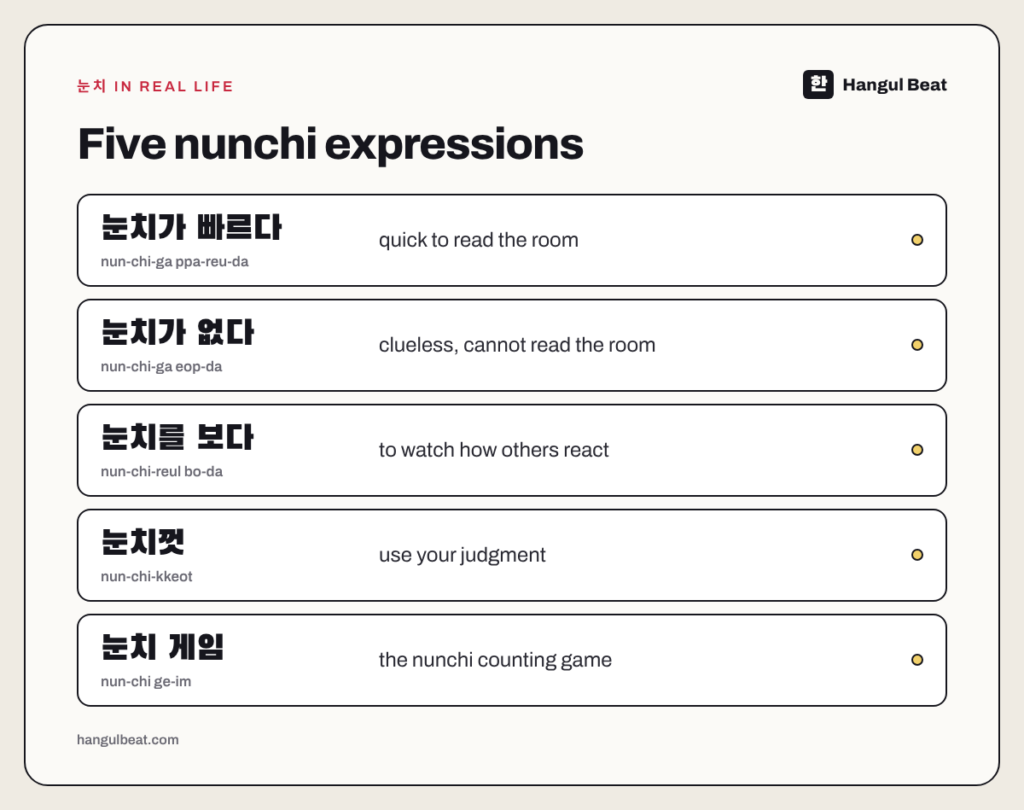
눈치 shows up in a lot of everyday expressions:
| Korean | Romanization | Meaning | Example |
|---|---|---|---|
| 눈치가 빠르다 | nun-chi-ga ppa-reu-da | quick to read the room | 너 진짜 눈치 빠르다! You catch on fast! |
| 눈치가 없다 | nun-chi-ga eop-da | clueless | 저 사람 눈치가 없어, that person can’t read the room |
| 눈치를 보다 | nun-chi-reul bo-da | to watch how others react | Being careful, a little nervous |
| 눈치껏 | nun-chi-kkeot | use your judgment | 눈치껏 해, just read the situation |
| 눈치 챙겨 | nun-chi chaeng-gyeo | read the room! | A playful warning between friends |
눈치를 보다 is interesting because it’s slightly different from having good nunchi. It means you’re watching others carefully, often because you’re unsure or a little anxious. A new employee might 눈치를 보다 on their first day, checking what everyone else does before acting.
눈치 챙겨 is the one you’ll hear in variety shows and in comments. 챙기다 means “to take care of” or “to pack,” so it’s like saying “pack your nunchi!” or “bring your awareness with you!”
The Nunchi Game
Koreans even turned 눈치 into a party game. In 눈치 게임 (the nunchi game), a group counts up from one, but there’s no order. Anyone can stand up and shout the next number at any moment. If two people say the same number at the same time, they lose, and so does whoever is last to call a number.
The whole game is about reading everyone else: who looks ready to jump in, who is hesitating, and when there’s a safe gap. It’s a staple at school trips and parties, and it shows up often on Korean variety shows because the moments when two people shout at once are always funny.
Why K-pop Idols Need 눈치
If you watch Korean variety shows, you’ve seen 눈치 in action. A good guest knows when to let a senior talk, when to jump in with a joke and when to pass the moment to a member who hasn’t spoken yet. Fans often praise an idol as 눈치가 빠르다 when they save an awkward moment or quietly help a teammate.
On stage, it’s the same skill in a different form. Members watch each other constantly, covering for a missed step, sharing the spotlight or reading the crowd’s energy to know when to push harder. Group activity is basically 눈치 practice, every single day.
Pronunciation Tips
- 눈치 is “nun-chi.” The ㅊ is aspirated, so push out a small puff of air. Our aspirated consonants guide explains this sound.
- 빠르다 starts with a tense ㅃ. Say “pp” with no puff of air. See our double consonants guide.
- 눈치껏 is “nun-chi-kkeot.” The final ㅅ sounds like a quick, stopped “t.”
- 챙겨 is “chaeng-gyeo.” Keep the ㅇ soft and nasal before ㄱ.
Nunchi FAQ
What does nunchi mean in English?
눈치 means the ability to read the room, sensing how others feel and what a situation needs without being told. It’s often translated as “eye measure.”
Is nunchi a compliment?
Yes. Saying someone’s 눈치가 빠르다 (quick nunchi) is praise. Saying they have no 눈치 (눈치가 없다) is a gentle criticism.
How do you play the nunchi game?
Players count up from one in no fixed order. Anyone can call the next number, but if two people say it at the same time, they lose.
What does 눈치 챙겨 mean?
It’s a casual way of saying “read the room!” Friends use it to playfully warn someone who is missing an obvious hint.
Final Thoughts
눈치 is one of those Korean words that explains a lot about Korean life, from office manners to idol variety shows. Once you know it, you’ll notice it everywhere: in a quiet pause, a quick glance or a perfectly timed joke. And the best way to learn it is the same way Koreans do, by watching closely.
Tell us in the comments: Which K-pop idol do you think has the best 눈치?
Keep Reading
- Jeong meaning: the Korean word for deep attachment
- Korean honorifics for K-pop fans
- Aegyo meaning
- Heung meaning: the Korean word for joyful energy
Sources: Publishers Weekly: The Power of Nunchi · World Economic Forum: The Power of Nunchi, an extract · The Guardian via PressReader: Euny Hong on nunchi · The Sun Malaysia: book review