Korean Aspirated Consonants: How to Hear 가, 카 and 까
Korean aspirated consonants are the four “breathy” sounds of Korean: ㅋ, ㅌ, ㅍ and ㅊ. You make them with a strong puff of air, and that puff is what separates 카 from 가 and 까. If you’ve ever wondered why 불, 풀 and 뿔 sound almost the same to you but mean fire, grass and horn, this is the reason.
In this post, we’ll explain Korea’s three-way consonant system, an easy test you can do with a tissue, word pairs to practice and K-pop words where these sounds show up all the time.
Korea’s Three-Way Sound System
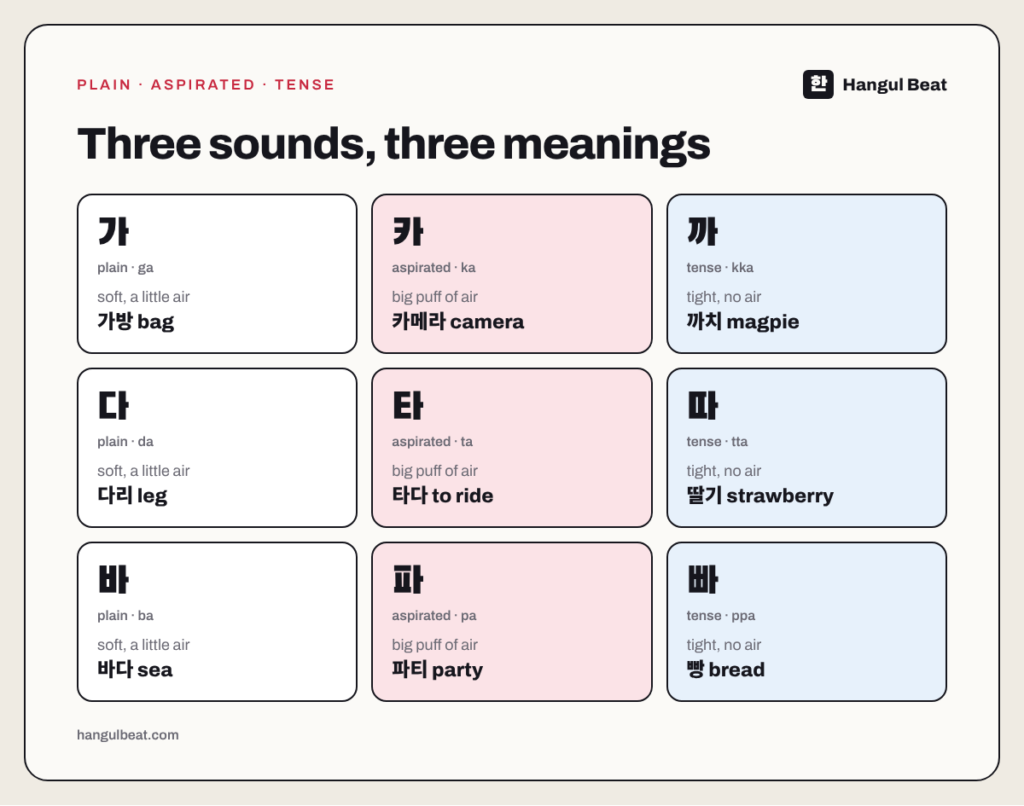
English mostly splits sounds into two groups, like k and g, or t and d. Korean splits them into three. The National Institute of Korean Language describes them as plain sounds (예사소리), aspirated sounds (거센소리) and tense sounds (된소리).
| Plain (예사소리) | Aspirated (거센소리) | Tense (된소리) |
|---|---|---|
| ㄱ | ㅋ | ㄲ |
| ㄷ | ㅌ | ㄸ |
| ㅂ | ㅍ | ㅃ |
| ㅈ | ㅊ | ㅉ |
The Korean name 거센소리 literally means “rough sound” or “strong sound.” The Institute notes that plain sounds feel soft and gentle, tense sounds feel hard and tight, and aspirated sounds feel stronger and rougher than plain ones. That rough feeling comes from the burst of air.
We covered the tense sounds in our Korean double consonants guide. This post completes the set.
Three Sounds, Three Meanings
Here’s what the three groups sound like side by side:
| Group | How to say it | Feel |
|---|---|---|
| Plain ㄱ ㄷ ㅂ ㅈ | Relaxed, a little air | Soft and gentle |
| Aspirated ㅋ ㅌ ㅍ ㅊ | Big puff of air | Strong and breathy |
| Tense ㄲ ㄸ ㅃ ㅉ | Tight throat, no air | Hard and sharp |
The difference isn’t just style. It changes meaning:
- 불 (bul) fire · 풀 (pul) grass · 뿔 (ppul) horn
- 달 (dal) moon · 탈 (tal) mask · 딸 (ttal) daughter
- 자다 (ja-da) to sleep · 차다 (cha-da) to kick, to be cold · 짜다 (jja-da) to be salty
Say the wrong one and you might tell someone the soup is “kicking” instead of “salty.” That’s why it’s worth practicing.
The Tissue Test
The easiest way to check your aspirated sounds is with a tissue or a small strip of paper.
- Hold a tissue about 5 cm (2 inches) in front of your lips.
- Say 카 (ka). The tissue should move clearly, because of the puff of air.
- Now say 까 (kka). The tissue should barely move, because tense sounds have almost no air.
- Finally, say 가 (ga). You’ll get a small movement, somewhere in between.
Try the same with 파, 빠 and 바, and with 차, 짜 and 자. Once you feel the difference in the tissue, you’ll start hearing it in songs too.
(Optional image · Canva 검색어: “tissue paper breath test” · 이 문단 아래 · alt: A tissue held in front of the mouth to test Korean aspirated consonants · 없으면 이 줄 삭제)
When Plain Sounds Become Aspirated
Here’s a rule that surprises many learners. When ㅎ sits next to ㄱ, ㄷ, ㅂ or ㅈ, the two merge into an aspirated sound. The National Institute of Korean Language gives examples like these:
- 놓고 (put and) sounds like [노코], no-ko
- 각하 (Your Excellency) sounds like [가카], ga-ka
- 맏형 (oldest brother) sounds like [마탱], ma-tyeong
- 옷 한 벌 (one piece of clothing) sounds like [오탄벌], o-tan-beol
So even when you don’t see ㅋ, ㅌ, ㅍ or ㅊ written, you may need to say one. Our silent H guide covers more ways ㅎ changes the sounds around it.
Practice With K-pop Words
Aspirated sounds are everywhere in K-pop. Try these out loud, and check the tissue each time:
| Word | Romanization | Meaning |
|---|---|---|
| 카리나 | ka-ri-na | Karina, the aespa member |
| 타이틀곡 | ta-i-teul-gok | title track |
| 팬 | paen | fan |
| 춤 | chum | dance |
| 체포 | che-po | arrest, from ILLIT’s 체포하겠어 |
| 컴백 | keom-baek | comeback |
컴백 is a fun one because it uses two aspirated sounds in a row. Koreans borrowed the English word comeback and wrote it with ㅋ, which is how most English words starting with k, t, p and ch get written in Korean.
Why Romanization Can Fool You
Romanization is part of the problem. Under the old system, Korean marked aspirated sounds with an apostrophe, so 카 was k’a. The National Institute of Korean Language noted that people dropped the apostrophe so often that plain and aspirated sounds ended up looking the same in English letters. The current system, introduced in 2000, writes ㄱ as g and ㅋ as k to fix that.
Even so, romanization can only hint at the sound. The real difference is the air, so trust your ears and the tissue more than the letters.
My Take: Breath Is Rhythm
When you listen closely to Korean performers, you can hear how much aspirated sounds add to the rhythm. A line full of ㅋ and ㅊ hits harder, almost like a percussion part, while soft plain sounds glide. Rappers and vocal coaches know this well, and it’s one reason Korean lyrics can sound so punchy.
For fans singing along, that’s good news. If you get the puff of air right, you’ll instantly sound more natural, even if your vocabulary is still small.
Start with three pairs today: 불 and 풀, 달 and 탈, 자다 and 차다. A few minutes with a tissue will do more than an hour of reading.
Korean Aspirated Consonants FAQ
What are the Korean aspirated consonants?
They are ㅋ, ㅌ, ㅍ and ㅊ. You say them with a strong puff of air, and in Korean they’re called 거센소리.
What’s the difference between 가, 카 and 까?
가 is plain with a little air, 카 is aspirated with a big puff of air, and 까 is tense with a tight throat and almost no air.
How can I tell if I’m saying ㅋ correctly?
Hold a tissue in front of your mouth. It should move clearly when you say 카, and barely move when you say 까.
Why does 놓고 sound like 노코?
When ㅎ meets ㄱ, ㄷ, ㅂ or ㅈ, the two sounds merge into an aspirated one. So ㅎ plus ㄱ becomes ㅋ.
Final Thoughts
Korean aspirated consonants come down to one simple thing: air. Once you feel the difference between 가, 카 and 까, a lot of Korean suddenly makes sense, from everyday words to K-pop titles like 체포하겠어. Grab a tissue, try the pairs, and listen for that puff in your favorite songs.
Tell us in the comments: Which is hardest for you: ㅋ, ㅌ, ㅍ or ㅊ?
Keep Reading
- Korean double consonants
- Korean batchim: final consonants made easy
- Korean linking sounds
- Korean R or L
Sources: National Institute of Korean Language: plain, aspirated and tense sounds · National Institute of Korean Language: how the three sounds feel · National Institute of Korean Language: sound changes between words · National Institute of Korean Language: romanization of consonants