Korean Batchim Explained: 3 Simple Rules for Final Consonants
Have you ever noticed that 감사합니다 doesn’t sound like “gam-sa-hap-ni-da” when idols say it? The secret is Korean batchim, the consonant that sits at the bottom of a syllable. Batchim changes sound depending on what comes next, and three simple rules explain almost all of it.
In this guide, we’ll show you what batchim is, the only seven sounds it can make, and how it links and changes in real words you hear in K-pop.
What Is Batchim?
Korean letters are stacked into syllable blocks. Most blocks start with a consonant and a vowel, like 사 (sa). Some blocks add one more consonant at the bottom, like 사 + ㅇ = 상 (sang). That bottom consonant is called 받침 (bat-chim).
The word itself means “support” or “something placed underneath,” which is exactly where it sits.
Some common words with batchim: 사랑 (sa-rang, love), 꿈 (kkum, dream), 밤 (bam, night), 봄 (bom, spring).
Rule 1: Only Seven End Sounds
Korean has many consonant letters, but at the end of a syllable they all collapse into just seven sounds.
| End sound | Letters that make it | Example |
|---|---|---|
| k | ㄱ, ㅋ, ㄲ | 부엌 (bu-eok), kitchen |
| n | ㄴ | 눈 (nun), eye/snow |
| t | ㄷ, ㅅ, ㅆ, ㅈ, ㅊ, ㅌ, ㅎ | 꽃 (kkot), flower |
| l | ㄹ | 별 (byeol), star |
| m | ㅁ | 밤 (bam), night |
| p | ㅂ, ㅍ | 앞 (ap), front |
| ng | ㅇ | 사랑 (sa-rang), love |
That’s why 꽃 (flower), 옷 (clothes) and 낮 (daytime) all end in the same short “t” sound.
Tip: Don’t pop the final k, t or p. Close your mouth into position and stop, without releasing air. It should sound clipped, like the “p” in “up” said very quietly.
Rule 2: Batchim Moves to the Next Vowel
When the next syllable starts with ㅇ (which is silent at the start of a syllable), the batchim slides over and becomes the first sound of that syllable.
| Written | Sounds like | Meaning |
|---|---|---|
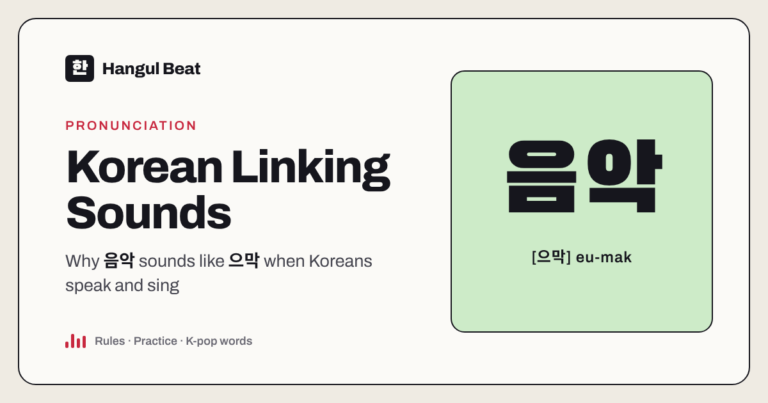
| 음악 | 으막 (eu-mak) | music |
| 한국어 | 한구거 (han-gu-geo) | Korean language |
| 맛있어 | 마시써 (ma-si-sseo) | it’s delicious |
| 옷이 | 오시 (o-si) | the clothes (subject) |
This is called linking, and it’s why Korean sounds so smooth and connected in songs.
Rule 3: Sounds Change Before ㄴ and ㅁ
When a k, t or p batchim comes right before ㄴ or ㅁ, it turns into a nasal sound:
- k → ng: 한국말 sounds like 한궁말 (han-gung-mal), Korean language
- t → n: 걷는 sounds like 걸는 (geon-neun), walking
- p → m: 감사합니다 sounds like 감사함니다 (gam-sa-ham-ni-da), thank you
This is why every formal -ㅂ니다 ending you hear in acceptance speeches sounds like “-m-ni-da.”
Practice With K-pop Words
| Word | Written romanization | How it sounds | Rule |
|---|---|---|---|
| 감사합니다 | gam-sa-hap-ni-da | gam-sa-ham-ni-da | Rule 3 |
| 음악 | eum-ak | eu-mak | Rule 2 |
| 사랑해 | sa-rang-hae | sa-rang-hae | ng ending (Rule 1) |
| 꽃 | kkot | kkot (clipped) | Rule 1 |
| 밤편지 | bam-pyeon-ji | bam-pyeon-ji | m ending (Rule 1) |
| 맛있어 | mat-iss-eo | ma-si-sseo | Rule 2 |
밤편지 is the Korean title of IU’s Through the Night. Read what Through the Night (밤편지) means to learn more. For the vowel sounds in these words, see our guide on how to pronounce Korean vowels.
Common Mistakes to Avoid
- Adding an extra vowel at the end. Many learners say 밥 (bap, rice) like “bap-uh.” In Korean, the word simply stops on the closed “p.” Close your lips and let the sound end there.
- Reading romanization letter by letter. Romanization shows how a word is spelled, not always how it sounds. That’s why 감사합니다 is written “hap-ni-da” but said “ham-ni-da.”
- Forgetting to link. Saying 음악 as two separate blocks, “eum… ak,” sounds choppy. Let the ㅁ slide into the next vowel: eu-mak.
- Mixing up ㅇ at the start and the end. At the start of a syllable, ㅇ is silent. At the bottom, it’s a clear “ng,” as in 사랑.
Final Thoughts
Korean batchim looks tricky on paper, but it follows a few steady rules: seven end sounds, linking before vowels, and nasal changes before ㄴ and ㅁ. Learn these three, and you’ll start reading Korean the way it actually sounds.
Which word surprised you the most once you knew the rules? Tell us in the comments!
Sources: Korean phonology – Wikipedia