Korean Linking Sounds: Why 음악 Sounds Like 으막
Korean linking sounds are the reason Korean often sounds different from how it’s written. When a syllable ends in a consonant and the next syllable starts with a silent ㅇ, the consonant slides over and is pronounced at the start of the next syllable. That’s why 음악 (music) is said like 으막, and 한국어 (Korean) like 한구거.
If you’ve ever read along to a K-pop song and felt lost because the sounds didn’t match the letters, this is probably the rule you were missing. In this post, we’ll explain how linking works, the exceptions you need to know, and K-pop words you can practice with today.
What Is 연음?
In Korean, this rule is called 연음 (yeon-eum), which means “connected sound.” It’s written into Korea’s official Standard Pronunciation rules, and it works like this:
- A syllable ends in a final consonant, called 받침 (bat-chim).
- The next syllable starts with ㅇ, which is silent at the start of a syllable.
- The 받침 moves over and fills that empty spot.
So 음 + 악 becomes [으 + 막]. The ㅁ at the end of 음 slides into the empty ㅇ of 악. You still write 음악, but you say 으막.
If 받침 is new to you, start with our Korean batchim guide, then come back here.
Why Linking Makes Korean Flow
Korean speakers don’t pause between syllables. Linking is what makes words glide together instead of sounding choppy. Compare:
- Choppy: 믿 / 어 (mit / eo)
- Natural: [미더] (mi-deo)
The second one is how every Korean says it. Singers rely on linking even more, because a melody needs smooth, open syllables to hold a note. That’s why lyrics can feel faster than the text looks.
Practice With K-pop Words
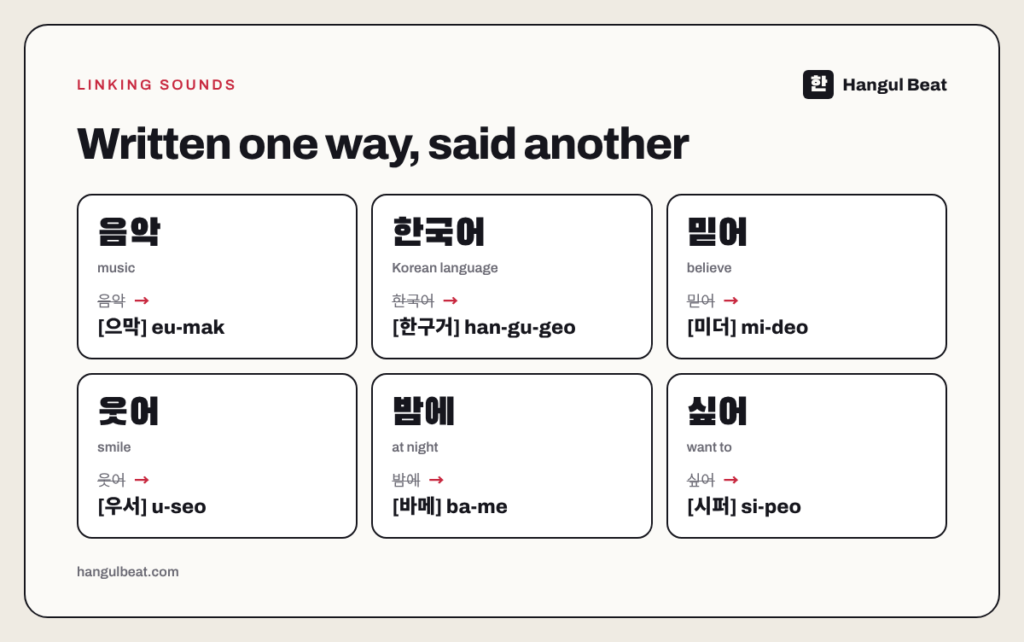
These words show up in K-pop songs all the time. Read the left side, then say the right side:
| Written | Said | Meaning |
|---|---|---|
| 음악 | [으막] eu-mak | music |
| 한국어 | [한구거] han-gu-geo | Korean language |
| 믿어 | [미더] mi-deo | believe me |
| 웃어 | [우서] u-seo | smile |
| 밤에 | [바메] ba-me | at night |
| 눈을 | [누늘] nu-neul | (your) eyes |
| 마음이 | [마으미] ma-eu-mi | the heart |
| 보고 싶어 | [보고 시퍼] bo-go si-peo | I miss you |
보고 싶어 is a great one to remember. Written word by word, it looks like “si-peo” should be “sip-eo,” but the ㅍ slides over and you get si-peo. Once you hear it, you’ll catch it in countless ballads.
The Exceptions You Need to Know
Linking is reliable, but a few cases work differently.
1. ㅇ doesn’t move. When the 받침 is ㅇ, it stays put, because ㅇ can’t be pronounced at the start of a syllable. So 사랑이 is “sa-rang-i,” not “sa-ra-ngi.” Same for 강에 (gang-e), “at the river.”
2. ㅎ disappears. A ㅎ 받침 on a verb or adjective usually drops out instead of linking. 좋아 is “jo-a,” and 넣어 is “neo-eo.” Our silent H guide covers this in detail.
3. Double 받침 splits. When a syllable has two final consonants, the first stays and only the second moves. 읽어 (read) becomes [일거], 앉아 (sit) becomes [안자], and 없어 (there isn’t) becomes [업써], with the ㅅ turning tense.
4. ㄷ and ㅌ can change. When ㄷ or ㅌ meets 이, it turns into ㅈ or ㅊ. 같이 (together) is said [가치], not “ga-ti.” That’s a separate rule, but it shows up in so many songs that it’s worth knowing now.
5. Two real words behave differently. When the second part is a word with its own meaning, the 받침 changes to its basic sound before linking. 맛없다 (tasteless) is [마뎍따]. The famous exception is 맛있다 (delicious), where both [마딛따] and [마싣따] are accepted as standard.
(Optional image · Canva 검색어: “connected dots line” · 이 문단 아래 · alt: Two dots joined by a line, showing how Korean sounds link together · 없으면 이 줄 삭제)
A Common Mistake, Even in Songs
Here’s a fun fact. The National Institute of Korean Language once pointed out that people often get linking wrong with 받침 like ㅊ and ㅌ, and that these wrong versions show up a lot in pop songs. For example, 꽃을 (the flower) should be [꼬츠], and 끝을 (the end) should be [끄틀], but you’ll often hear [꼬슬] and [끄츠] in songs and everyday speech.
So if a word in a song doesn’t match the rule perfectly, don’t panic. Singers sometimes bend pronunciation for style. Learn the standard version first, and you’ll be able to hear when an artist is playing with it.
How to Practice
- Read slowly, then fast. Say 믿어 as “mit-eo” first, then speed up until it naturally becomes [미더].
- Mark the link. When you read Korean lyrics, draw a small arrow from each 받침 to the next ㅇ. It trains your eye to expect the shift.
- Shadow a song. Pick a slow ballad, play one line, pause, and repeat it out loud. Ballads are easier than dance songs because every syllable is clear.
- Check yourself. Record your voice and compare it with the original. Linking is easy to hear once you listen for it.
My Take: Why Fans Sound Better Than They Think
When international fans sing along in Korean, the difference between “close” and “natural” is almost always linking. The vowels are usually fine. What gives it away is a little pause after each 받침, where a Korean speaker would just glide through.
The good news is that it’s one of the easiest habits to fix. Once you start linking, your Korean instantly sounds smoother, and lyrics stop feeling like they’re racing ahead of you.
Try it with just three words today: 음악, 믿어 and 보고 싶어. Say them ten times each, linked. Then put on your favorite song and listen for them.
Korean Linking Sounds FAQ
What is 연음 in Korean?
연음 (yeon-eum) is the linking rule: a final consonant moves to the next syllable when that syllable starts with a silent ㅇ. 음악 is pronounced [으막].
Why does 사랑이 not link?
Because the 받침 is ㅇ, which can’t be pronounced at the start of a syllable. It stays where it is: sa-rang-i.
How do you pronounce 보고 싶어?
Say [보고 시퍼], bo-go si-peo. The ㅍ of 싶 links to the next syllable.
Is 맛있다 pronounced 마싣따 or 마딛따?
Both are accepted as standard Korean pronunciation. 마싣따 is the one you’ll hear most in daily life.
Final Thoughts
Korean linking sounds are a small rule with a big payoff. Once you know that 받침 slides into the next ㅇ, Korean suddenly matches what you hear, and K-pop lyrics become much easier to follow. Start with 음악 [으막] and 보고 싶어 [보고 시퍼], and you’ll start hearing it everywhere.
Tell us in the comments: Which Korean word surprised you the most when you heard how it’s really pronounced?
Keep Reading
- Korean batchim: final consonants made easy
- The silent H in Korean
- Korean double consonants
- How to pronounce Korean vowels
Sources: National Institute of Korean Language: Understanding standard pronunciation, linking · National Institute of Korean Language: Exceptions to linking · National Institute of Korean Language: Final consonant sounds · Yugacrew: 연음법칙 and Standard Pronunciation rules 13–15