Silent H in Korean: Why 좋아 Sounds Like Joa
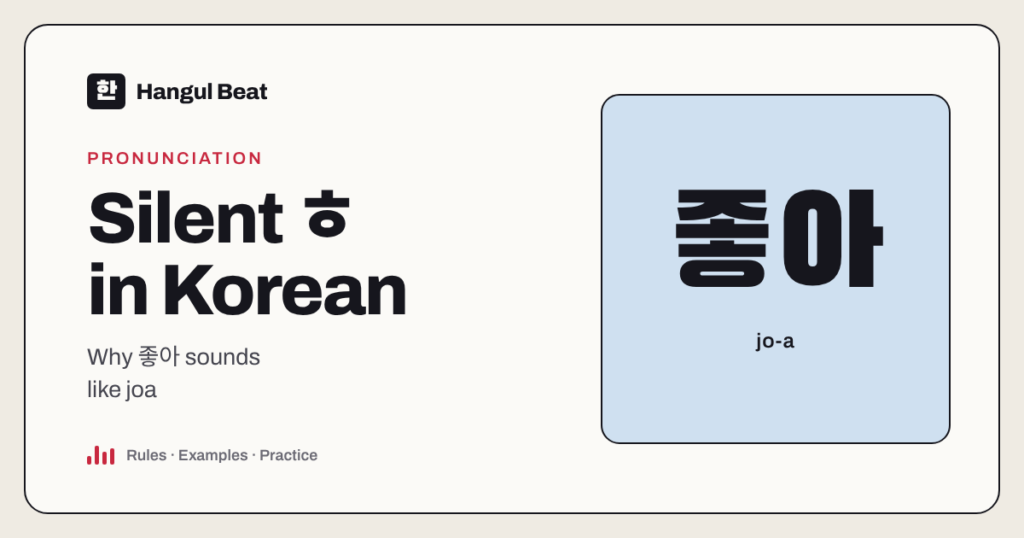
Why does 좋아 sound like “joa” when it’s clearly spelled with a ㅎ? The answer is the silent H in Korean. The letter ㅎ (h) at the bottom of a syllable almost never sounds like an English “h.” Depending on what comes next, it disappears, makes the next sound stronger, or turns into a completely different sound.
The good news: there are only four rules, and you already hear them in K-pop every day. Words like 좋아 (I like it), 괜찮아 (it’s okay) and 축하해 (congratulations) all follow them. By the end of this guide, you’ll know exactly why they sound the way they do.
Why ㅎ Changes at the Bottom of a Syllable
In Korean, a consonant at the bottom of a syllable is called 받침 (batchim). Most batchim simply “close” the syllable, but ㅎ is special: it’s a breathy sound with no strong shape of its own, so it blends into whatever comes after it. Korea’s official pronunciation rules, set by the National Institute of Korean Language, describe exactly how. If batchim is new to you, start with our Korean batchim guide.
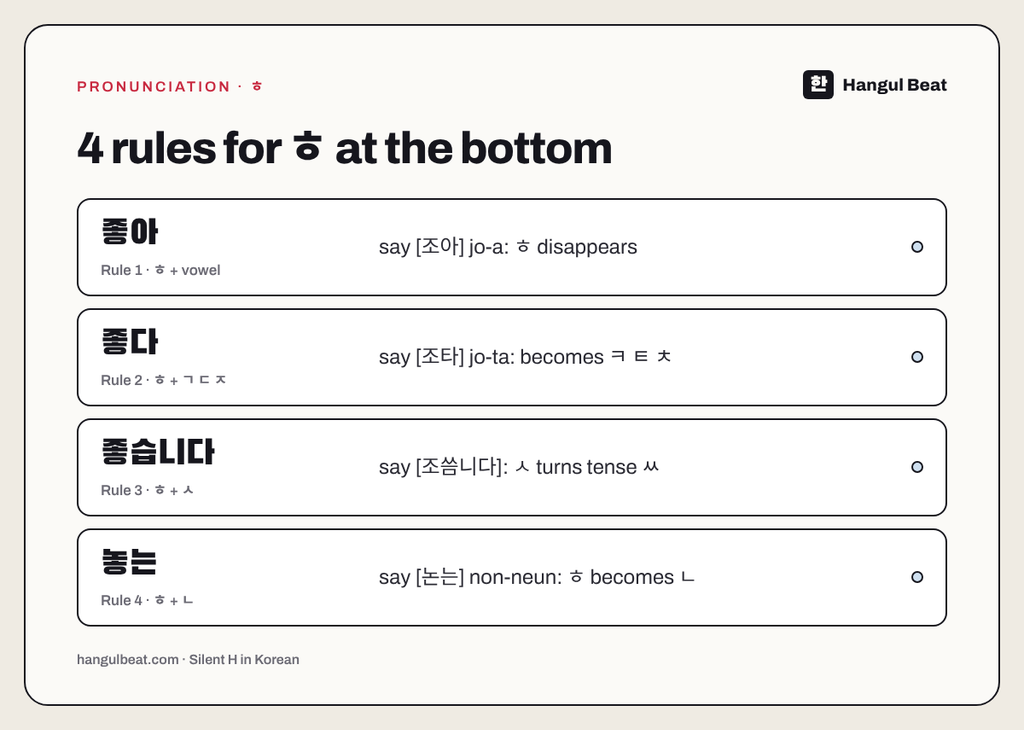
The 4 ㅎ Rules at a Glance
| Rule | When ㅎ meets… | What happens | Example |
|---|---|---|---|
| 1 | a vowel | ㅎ disappears | 좋아 → [조아] jo-a |
| 2 | ㄱ, ㄷ, ㅈ | they become ㅋ, ㅌ, ㅊ | 좋다 → [조타] jo-ta |
| 3 | ㅅ | ㅅ becomes ㅆ | 좋습니다 → [조씀니다] jo-sseum-ni-da |
| 4 | ㄴ | ㅎ becomes ㄴ | 놓는 → [논는] non-neun |
Rule 1: ㅎ + Vowel = Silent
When a syllable ending in ㅎ is followed by a vowel, the ㅎ simply isn’t pronounced. This is the rule behind 좋아:
- 좋아 (I like it) → [조아] jo-a
- 괜찮아 (it’s okay) → [괜찮나] gwaen-cha-na
- 많아 (it’s a lot) → [마나] ma-na
- 싫어 (I don’t want it) → [시러] si-reo
Notice the last three. When the batchim is a double one like ㄶ or ㅀ, the ㅎ drops out and the remaining ㄴ or ㄹ slides into the next syllable. That’s why 괜찮아 sounds like “gwaen-cha-na” and 싫어 sounds like “si-reo.”
Rule 2: ㅎ + ㄱ, ㄷ, ㅈ = Stronger Sound
When ㅎ meets ㄱ, ㄷ or ㅈ, the two sounds merge into an aspirated (breathy) consonant: ㅋ, ㅌ or ㅊ.
- 좋다 (it’s good) → [조타] jo-ta
- 좋고 (good, and…) → [조코] jo-ko
- 좋지 (it’s good, right?) → [조치] jo-chi
It also works in reverse. When ㄱ, ㄷ, ㅂ or ㅈ sits before a ㅎ, they merge too. This is why the birthday song you hear at every Korean party sounds the way it does:
- 축하해 (congratulations) → [추카해] chu-ka-hae
- 입학 (school entrance) → [이펭] i-pak
- 백화점 (department store) → [배콰점] bae-kwa-jeom
(Optional image · Canva 검색어: “birthday cake candles” · 이 목록 아래, 축하해 예시용 · alt: A birthday cake for the Korean word 축하해 · 없으면 이 줄 삭제)
Rule 3: ㅎ + ㅅ = ㅆ
When ㅎ meets ㅅ, the ㅎ disappears and the ㅅ becomes the tense ㅆ.
- 좋습니다 (it’s good, formal) → [조씀니다] jo-sseum-ni-da
- 많습니다 (there are many, formal) → [만씀니다] man-sseum-ni-da
You’ll hear this one in formal speech: award speeches, announcements and news. Our guide to Korean double consonants shows how to make the tense ㅆ.
Rule 4: ㅎ + ㄴ = ㄴ
When ㅎ meets ㄴ, the ㅎ turns into an ㄴ sound too, so you hear a double “n.”
- 놓는 (putting down) → [논는] non-neun
- 좋네 (oh, that’s nice) → [존네] jon-ne
Bonus: The ㅎ That Fades in Everyday Speech
There’s one more thing to listen for. Even at the start of a syllable, ㅎ often gets very weak in fast, casual speech when it comes after a vowel or after ㄴ, ㄹ, ㅁ or ㅇ. Officially it should be pronounced, but in real conversation you’ll hear:
- 은행 (bank) sounding close to [으냉] eu-naeng
- 전화 (phone) sounding close to [저놌] jeo-nwa
- 사랑해 (I love you) sounding close to “sa-rang-ae” when sung quickly
So if 사랑해 in a song sounds like it has no “h,” your ears aren’t wrong.
Practice: Read These Out Loud
Cover the right column and try each word first.
| Written | Say it like | Rule |
|---|---|---|
| 넣어 | 너어 (neo-eo) | 1 |
| 않아 | 아나 (a-na) | 1 |
| 어떻게 | 어떠케 (eo-tteo-ke) | 2 |
| 그렇지 | 그러치 (geu-reo-chi) | 2 |
| 싫습니다 | 실씀니다 (sil-sseum-ni-da) | 3 |
| 쌓네 | 싼네 (ssan-ne) | 4 |
어떻게 (how) is a great one to remember. Fans type it constantly, and it always sounds like “eo-tteo-ke.”
My Take: The Word You Hear at Every Celebration
At Korean ceremonies and award shows, one word you hear again and again is 축하합니다, “congratulations.” MCs say it at award moments, hosts say it to winners, and crowds shout it back. Nobody says “chuk-ha-ham-ni-da” letter by letter. It always comes out as “chu-ka-ham-ni-da,” smooth and fast.
That’s the best way to think about ㅎ. These rules aren’t extra grammar to memorize. They’re simply what happens when Koreans speak at a natural speed. If you spell-read every letter, you’ll sound careful but stiff. If you let the ㅎ blend the way the rules describe, you’ll sound like someone who has actually heard Korean spoken in a room full of people.
My suggestion: pick five words from this page, listen for them in your favorite songs this week, and copy the sound you hear, not the spelling you see.
Silent H FAQ
Why is 좋아 pronounced “joa”?
Because ㅎ at the bottom of a syllable is silent when the next syllable starts with a vowel. 좋 + 아 becomes [조아], so you hear “jo-a.”
Why does 축하해 sound like “chukae”?
When ㄱ meets ㅎ, they merge into the breathy ㅋ sound. So 축하해 is pronounced [추카해], chu-ka-hae.
Is the ㅎ in 사랑해 silent?
Officially it’s pronounced, but in fast or sung Korean it often becomes so soft that it almost disappears, so 사랑해 can sound like “sa-rang-ae.”
Do I need to learn these rules to understand K-pop?
Not by heart, but knowing them helps a lot. Once you know why 좋아 sounds like “joa,” lyrics and subtitles that seemed not to match will suddenly make sense.
Final Thoughts
The silent H in Korean comes down to four simple patterns: gone before a vowel, stronger before ㄱ/ㄷ/ㅈ, tense before ㅅ and “n” before ㄴ. Learn them once, and words like 좋아, 괜찮아 and 축하해 will never trip you up again.
Which ㅎ word surprised you the most? Tell us in the comments!
Keep Reading
- Korean batchim explained: 3 simple rules for final consonants
- Korean double consonants: how to say ㄲ ㄸ ㅃ ㅆ ㅉ
- Korean R or L? How to pronounce ㄹ the easy way
- How to pronounce Korean vowels
Sources: National Institute of Korean Language: Understanding standard pronunciation (표준 발음법의 이해)