Heung Meaning: 흥, the Korean Word for the Joy That Makes You Move
What is the heung meaning? Dictionaries translate 흥 (heung) as “excitement” or “fun,” but that misses the best part. 흥 is the joyful energy that rises up inside you when the music is good and the people around you are into it, the feeling that makes you clap, shout, sing along and maybe start dancing before you’ve decided to.
If you’ve ever been in a crowd at a K-pop concert when every single person is singing, you’ve felt 흥. In this guide, we’ll explain what the word means, how Koreans use it every day, and why it sits at the heart of Korean music, from traditional pansori to modern K-pop.
What Does 흥 Mean?
흥 (heung, 興) is the feeling of joy and lively energy that makes you want to move and join in. It’s not quiet happiness. It’s happiness with rhythm.
A few things make 흥 special:
- It grows in a group. You can feel 흥 alone, but it’s strongest when it spreads from person to person.
- It comes out through the body. Clapping, shouting, dancing, swaying, singing along.
- It can be “woken up.” A good host, a great song or a funny friend can raise everyone’s 흥.
Koreans often say that Korean people have a lot of 흥. Whether or not that’s true for every person, it’s a big part of how Koreans see their own culture. You see it at festivals, at weddings, at sports games, at karaoke and, of course, at concerts.
How Koreans Use 흥 in Everyday Speech
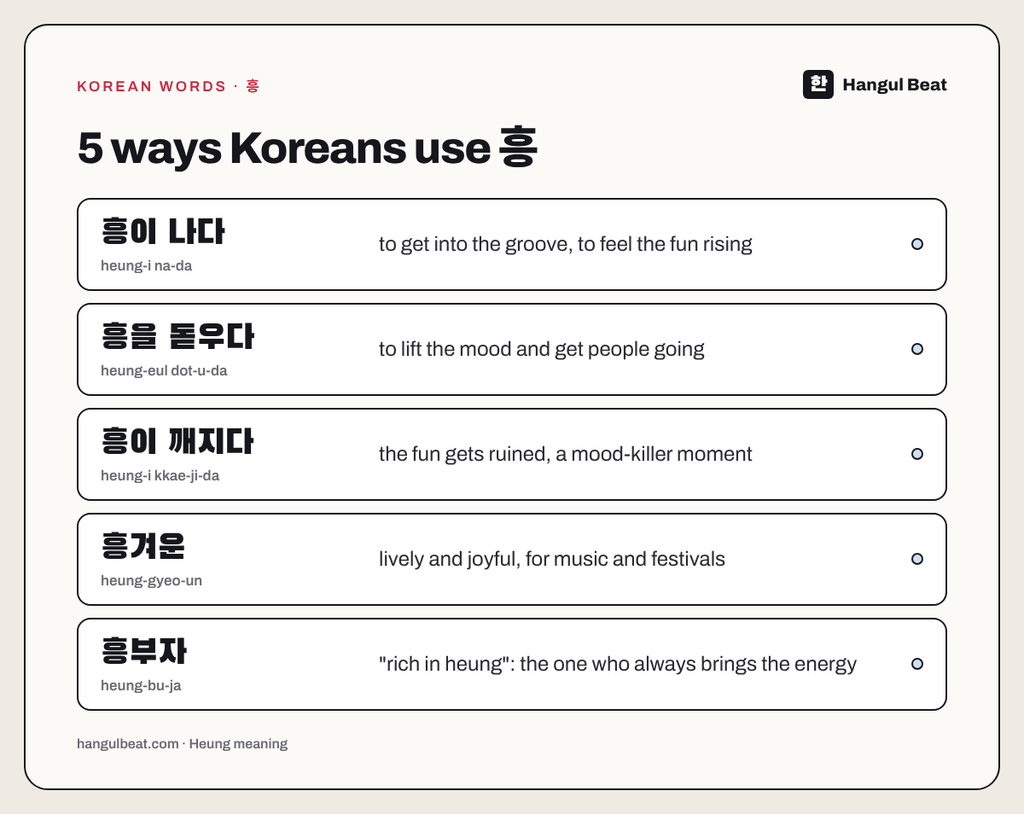
흥 rarely appears alone. It usually comes in set phrases:
| Korean | Romanization | Meaning |
|---|---|---|
| 흥이 나다 | heung-i na-da | to get into the groove, to feel the fun rising |
| 흥을 돋우다 | heung-eul dot-u-da | to lift the mood, to get people going |
| 흥이 깨지다 | heung-i kkae-ji-da | the fun gets ruined, a mood-killer moment |
| 흥겨운 | heung-gyeo-un | lively, joyful (used for music and festivals) |
| 흥부자 | heung-bu-ja | “rich in heung”: someone who always brings the energy |
흥부자 is a fun one. 부자 (bu-ja) means a rich person, so a 흥부자 is someone who is “rich” in fun energy: the friend who dances first, sings the loudest and gets everyone else to join. Korean variety shows love calling idols 흥부자 when they can’t stop dancing to every song.
And 흥이 깨지다 is what happens when someone ruins the moment: the music stops, someone gets too serious, or the party is told to quiet down.
흥 in Korean Traditional Music
To understand 흥, it helps to look at Korean traditional music, where the audience isn’t expected to sit silently.
In pansori (판소리), a singer tells a long story with a drummer beside them. The drummer and the audience call out short shouts called chuimsae (추임새) to cheer the singer on:
- 얼씨구! (eolssigu!) = “That’s it!”
- 좋다! (jota!) = “Good!”
- 잘한다! (jalhanda!) = “Well done!”
- 얼쓰! (eolssu!) = a cheerful shout with no exact translation
These shouts are 흥 turned into sound. They push the performer forward, and the performer feeds that energy back to the crowd. Stray Kids brought chuimsae into their hit Thunderous, whose Korean title means a pansori singer. Read more in our post on the Stray Kids Thunderous meaning.
You’ll also feel 흥 in pungmul (풍물), the loud percussion music of village bands, where gongs and drums lead people dancing through the streets.
흥 and Han: Two Sides of Korean Feeling
You may have read about 한 (han), a deep, lingering sorrow that is often described as a core Korean emotion. 흥 is often described as its opposite: bright, shared, bursting joy.
Many Korean songs hold both at once. A sad story told with a lively rhythm is very Korean. Even pansori, which tells stories of hardship, is full of chuimsae and laughter. Understanding both words helps you hear why some K-pop songs can feel happy and bittersweet at the same time.
흥 at K-pop Concerts: 떼창
Modern 흥 has its own word: 떼창 (tte-chang), a whole crowd singing along together. 떼 means a crowd or group, and 창 comes from singing.
Korean audiences are famous for 떼창. Fans learn every line, shout fan chants in the right places and sometimes keep singing after the music stops. From the side of someone who has run live events, this is the moment organizers hope for: when the audience becomes part of the show.
The best example in K-pop might be SEVENTEEN’s encore of Very Nice, which they sometimes perform again and again at the end of a concert because nobody wants the 흥 to stop. See our post on the SEVENTEEN Very Nice meaning, and our guide to Korean words for K-pop concerts.
Don’t Mix It Up: 흥! as a Sound
One warning. In comics and dramas, you’ll also see “흥!” used as a sound: a little “hmph!” when someone is sulking or pretending not to care. It’s spelled the same, but it’s a totally different word. If a character crosses their arms and says 흥, they’re not feeling the groove. They’re pouting.
How to Pronounce 흥
- 흥 is one syllable: heung.
- ㅎ is a soft “h.”
- ㅡ is an unrounded vowel. Pull your lips slightly back, like a small, flat smile, and say “uh” from the back of your mouth. Don’t round your lips into “oo.” Our Korean vowels guide explains this sound.
- ㅇ at the bottom is “ng,” like the end of “song.”
- In 흥이 나다, the “ng” stays with 흥 and doesn’t move to the next syllable: heung-i na-da.
My Take: Watching 흥 From the Side of the Stage
Because of my work, I usually watch shows from the side of the stage, not from the crowd. From there, you can actually see 흥 arrive. It rarely starts with the artist. It starts with a handful of people in the audience who clap a little louder or shout a little earlier than everyone else, and then it spreads, row by row, until the whole room is moving.
As an organizer, that’s the moment you plan for but can never fully control. You can choose the running order, time the lights and save the biggest song for the end. Whether the 흥 really comes still depends on the people in the room. That’s why Koreans say a good MC or a funny friend can “raise” someone’s 흥: it’s something a group builds together, not something one person delivers.
So if you’re heading to your first K-pop concert, my advice is simple. Don’t wait to see whether others will join in. Learn the fan chant, sing the chorus and be one of the first few voices. That’s how 흥 starts, and it’s the best way to understand what this word really
Final Thoughts
흥 is one of the best Korean words to know as a K-pop fan, because it names the feeling you already have when a song makes you move. It lives in the shouts of pansori, the drums of pungmul and the voices of thousands of fans singing together.
Who’s the biggest 흥부자 in your favorite group? Tell us in the comments!