Han Meaning: 한, the Korean Word for Deep, Unresolved Sorrow
What is the han meaning? 한 (han) is often called the most Korean emotion of all, and also the hardest to translate. English versions include “sorrow,” “grief,” “regret” and “resentment,” but none of them is enough on its own. 한 is all of those feelings knotted together and left unresolved, sometimes for a lifetime.
If you’ve ever heard a Korean ballad that sounds sad and stubborn at the same time, or watched a K-drama parent carry an old wound for decades, you’ve brushed up against 한. In this guide, we’ll explain what the word means, the everyday phrases built on it, where the idea comes from, and why you can’t fully understand 한 without its bright opposite, 흥.
What Does 한 Mean?
한 (han, 恨) is a deep, lingering sorrow mixed with regret and a sense of injustice. The Chinese character 恨 means resentment or regret, but in Korean the word has grown much wider.
A few things set 한 apart from ordinary sadness:
- It’s unresolved. 한 comes from something that was never made right: a loss, a wrong, a dream that couldn’t happen.
- It’s held inside. 한 isn’t loud anger. It sinks in and stays, sometimes for years.
- It’s often shared. Families, communities and even generations can carry the same 한.
- It has hope in it. Many writers describe 한 as sadness that still longs for things to be set right. Novelist Pak Kyongni described it as both sorrow and hope.
How Koreans Use 한 in Everyday Speech
한 appears in several common expressions:
| Korean | Romanization | Meaning |
|---|---|---|
| 한이 맺히다 | han-i mae-chi-da | sorrow becomes “knotted” inside you |
| 한을 풀다 | han-eul pul-da | to finally release or resolve your 한 |
| 한풀이 | han-pu-ri | the release of 한; also, making up for something you missed |
| 여한이 없다 | yeo-han-i eop-da | to have no regrets left |
| 한스럽다 | han-seu-reop-da | to feel deeply regretful |
한풀이 is the one you’ll hear most in daily life, often in a lighter way. Someone who couldn’t travel for years might call their first big trip a 한풀이. Someone who grew up without snacks might buy a whole cart of them as an adult, also a 한풀이.
여한이 없다 is the happy ending of 한. When someone finally meets a lifelong goal, they might say, “Now I have no 한 left.”
Where the Idea of 한 Comes From
한 is often linked to the hard chapters of modern Korean history: the Japanese colonial period, the division of the peninsula and the Korean War, which separated many families for good.
Historians also point out that the idea of 한 as a defining national trait is fairly modern. Scholars such as Minsoo Kang argue it took shape in the 20th century, partly from Japanese writer Yanagi Sōetsu’s 1919–1920 essays on the “beauty of sorrow” in Korean art. According to Kang, the word became less central in South Korea after the late 1990s, while it remains important to many Korean Americans.
So 한 is real and widely felt, but it isn’t a fixed gene every Korean is born with. It’s a word Koreans use to make sense of loss, and its meaning keeps changing.
한 and 흥: Two Sides of Korean Feeling
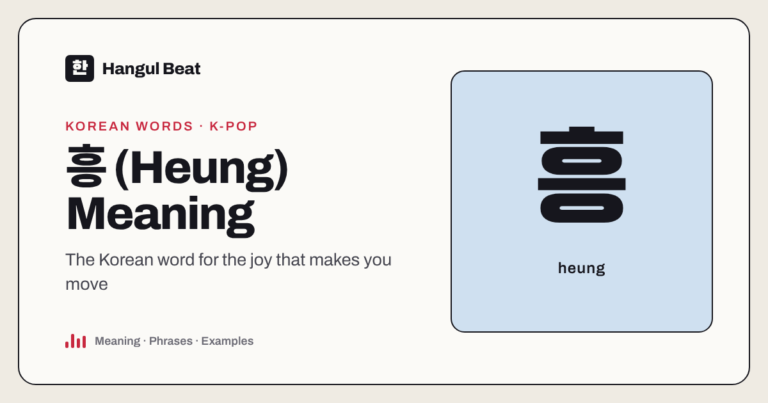
If 한 is sorrow that stays, 흥 (heung) is joy that bursts out. Korean music often holds both.
Traditional pansori is sometimes called “the sound of 한” because of its raw, aching voice. Yet the surviving pansori stories have happy endings, and performances are full of humor and cheering shouts. Many Koreans see this as the point: 흥 is how you live with 한. Stray Kids drew on pansori in Thunderous; read more in our post on the Stray Kids Thunderous meaning.
Here’s a quick way to keep three big Korean feeling words apart:
| Word | Feeling | Grows from |
|---|---|---|
| 한 (han) | lingering sorrow and regret | loss or injustice left unresolved |
| 흥 (heung) | lively, shared joy | music, people and good energy |
| 정 (jeong) | warm, lasting attachment | time spent together |
한 in Music and Film
- Arirang. Korea’s best-known folk song is often described as carrying 한, with its themes of parting and longing.
- Im Kwon-taek’s films. The director made many films about 한. His 1993 film Seopyeonje, about a family of pansori singers, is one of the most famous.
- K-pop and ballads. Songs about missing someone and waiting, like BTS’s Spring Day, aren’t “about 한,” but Korean listeners often hear its echoes in them. See our post on Spring Day by BTS.
The idea has even reached Western TV. The American drama The West Wing has an episode titled “Han.”
Don’t Mix It Up: Other Words Spelled 한
If you searched “han meaning,” you may have meant one of these instead:
- 한 = “one.” In counting, 한 means one: 한 개 (one item), 한 번 (once).
- 한 = Korea. 한국 (Hanguk) means Korea, and 한글 (Hangul) is the Korean alphabet. This 한 uses a different Chinese character (韓).
- 한강 (Han River). The river through Seoul uses yet another character (漢).
- Han as a name. 한 is a common family name, and it’s the stage name of Stray Kids’ Han.
When people talk about feelings, loss or the past, it’s the 한 of this post.
How to Pronounce 한
- ㅎ is a soft “h.”
- ㅏ is “ah,” like in “father.” Our Korean vowels guide explains it.
- ㄴ at the bottom is a clean “n.”
Put together, it sounds like “hahn,” not “hann” as in “hand.”
Han FAQ
Is han unique to Korea?
Every culture knows grief and regret. What’s distinctive is that Korean has one everyday word for this specific mix of lingering sorrow, injustice and longing, and that it became tied to how many Koreans talk about their history.
Do Koreans still feel han today?
The feeling is still recognized, and phrases like 한풀이 and 여한이 없다 are used every day. But many younger Koreans rarely describe themselves as carrying 한, and scholars note the word is used less in South Korea than it once was.
What is 한풀이?
한풀이 (han-pu-ri) means releasing 한. In serious contexts it’s about finally healing an old wound. In daily speech it’s often playful: doing something you always wanted to do but couldn’t.
Final Thoughts
한 is a heavy word, but it isn’t hopeless. It names the sadness that stays when something was never made right, and the quiet wish that one day it will be. Knowing 한, along with 흥 and 정, helps you hear the layers in Korean ballads, dramas and K-pop songs that sound sad and strong at the same time.
Have you ever had a 한풀이 moment, finally doing something you’d wanted for years? Tell us in the comments!
Sources: Han (cultural) – Wikipedia