BTS Spring Day Meaning: What “봄날” Really Means in Korean
What is the real BTS Spring Day meaning? Spring Day is one of BTS’s most loved songs, and its Korean title holds a feeling English can’t quite carry. “Spring day” sounds simple, but to Korean ears it means something closer to “the good days that come after a long winter.”
In this post, we’ll break down what “봄날” really means, the story behind the song, the symbols hidden in the music video, and a few Korean words that help you feel the song the way Korean fans do. No Korean knowledge needed.
Song Info
| Artist | BTS |
| Korean title | 봄날 (bom-nal) |
| Released | February 13, 2017 |
| Album | You Never Walk Alone (repackage of WINGS) |
| Mood | Wistful, hopeful ballad with a hip-hop backbone |
Want to sing along? Watch the official music video on the HYBE LABELS YouTube channel, and turn on the subtitles for the lyrics. For the full romanized lyrics, use a licensed lyrics service such as Genius or the lyrics view in Spotify or Apple Music.
What Does “봄날” Mean?
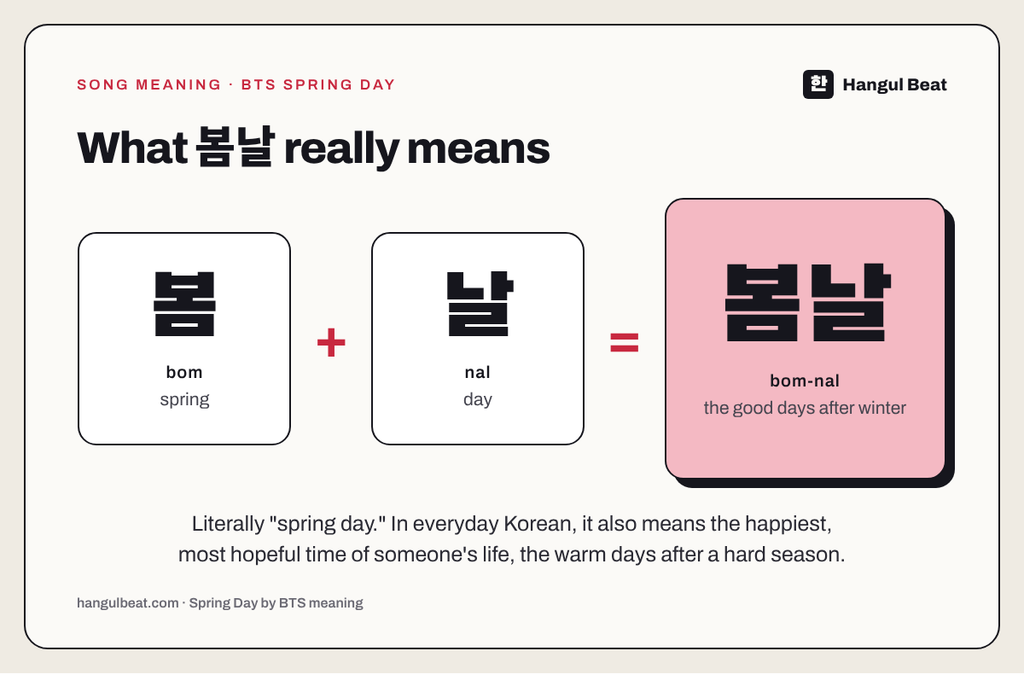
봄날 (bom-nal) is made of two simple words:
- 봄 (bom) = spring
- 날 (nal) = day
So the literal translation is “spring day.” But Koreans often use 봄날 as a metaphor for the good times in life, especially the ones that come after hardship.
You’ll hear it in everyday phrases like “내 인생의 봄날” (the spring days of my life), meaning someone’s happiest or most hopeful period. Older Koreans sometimes say a struggling person’s “봄날” will come, like saying “your time will come.”
That double meaning is the key to the song. It isn’t about the season. It’s about waiting through a cold, lonely stretch and believing that warmer days, and the people you miss, will come back.
The Story Behind the Song
Spring Day is, at its heart, a song about missing someone. In interviews, members have described it as being about longing for a friend you can no longer see, and the distance that time puts between people.
Because the song never spells out who is missing or why, it became a mirror for listeners. Some fans connected it to personal loss or friendship. Others in Korea read it as a quiet tribute to the victims of the 2014 Sewol ferry disaster, based on hints in the music video. BTS and their label have never confirmed a single meaning, and that openness is a big part of why the song still hits so many people differently.
It also became one of the longest-running hits in Korean chart history, staying on domestic streaming charts for years after release. In Korea, it’s the kind of song people return to every time winter turns into spring.
Hidden Symbols in the Music Video
The MV is packed with images that fans have been decoding since 2017. Here are the ones most often discussed. Keep in mind these are fan interpretations, not official explanations.
- The “Omelas” motel sign. A nod to Ursula K. Le Guin’s short story The Ones Who Walk Away from Omelas, about a perfect city whose happiness depends on one child’s suffering. Many fans read it as a question about the cost of comfort and who chooses to walk away.
- The snowy train and empty platform. Winter, waiting and leaving. The train suggests a journey toward something, or away from it.
- The pile of clothes. The members climb a mountain of clothing, an image many viewers link to absence and those who are no longer here.
- The tree with shoes. The members gather at a lone tree near the end. Some fans see it as a place of remembrance, and the reunion there as the arrival of “spring.”
Whatever you take from it, the MV moves from cold and isolation to togetherness, which mirrors the meaning of 봄날 itself.
Korean Words to Know
These everyday words capture the feeling of Spring Day. Learn them and you’ll start noticing them in K-dramas and other K-pop songs too.
| Korean | Romanization | Meaning | Why it matters |
|---|---|---|---|
| 봄 | bom | spring | A classic symbol of hope and new beginnings |
| 겨울 | gyeo-ul | winter | Often stands for loneliness or a hard season of life |
| 눈 | nun | snow | Same spelling as “eye” (눈); context tells you which |
| 그리움 | geu-ri-um | longing, missing someone | No single English word matches it |
| 기다림 | gi-da-rim | waiting | The noun form of 기다리다 (to wait) |
| 친구 | chin-gu | friend | In Korea, usually someone the same age as you |
| 벚꽃 | beot-kkot | cherry blossom | The flower Koreans most connect with spring |
Bonus word: 꽃샘추위 (kkot-saem-chu-wi) literally means “the cold that’s jealous of flowers.” Koreans use it for the sudden chill that hits just as spring begins, a perfect picture of how hard it can be to leave winter behind.
Pronunciation Tips
Romanization helps, but a few Korean sounds trip up almost every learner. Get these right and you’ll sound much more natural when you sing along.
- 봄 is not “bomb.” The ㅗ is a short, round “o,” like in “boat” without the glide at the end. The ㅂ is softer than an English “b.”
- 날 ends with a light “l.” Touch your tongue to the roof of your mouth and stop. Don’t roll it.
- 겨울’s ㅓ isn’t “o.” It’s closer to the “u” in “but,” so it sounds like “gyuh-ool,” not “gyo-ool.”
- 벚꽃 has a tense “kk.” The double consonant ㄲ is said with a tight throat and no puff of air, sharper than a normal “k.”
Try saying each word slowly, then at singing speed while the MV plays.
My Take: Why 봄날 Hits Differently in Korea
Living in Korea, I hear the word 봄날 far more often than most people outside the country might expect. Older Koreans use it to talk about the best years of their lives, and people tell a friend going through a hard time that their 봄날 will come. So when Koreans hear BTS sing about a spring day, they don’t just picture flowers. They hear a promise that hard times end.
I’ve spent about 20 years planning concerts and live events here, and I’ve learned that slow songs often say more about an audience than fast ones. A dance track gets everyone moving, but a ballad like this makes a crowd go quiet together, and you can feel that people are each thinking of someone specific. That shared silence is one of the most powerful things that can happen at a show.
That’s also why I think Spring Day keeps coming back on the charts every year when winter ends. It isn’t nostalgia for 2017. Every spring, people find a new person to miss and a new reason to believe warmer days are coming. If you listen to it this spring, try thinking of your own 봄날 and who you hope will be there for it.
Spring Day FAQ
What is Spring Day by BTS about?
Spring Day is a song about missing someone you can no longer see and waiting for the day you meet again. The title, 봄날, means “spring day,” but in Korean it also means the good times that come after a hard season. So the song is less about the weather and more about getting through a cold, lonely stretch and believing better days will come.
What does 봄날 mean in Korean?
봄날 (bom-nal) combines 봄 (spring) and 날 (day). Literally it is “spring day,” but Koreans often use it to mean the happiest or most hopeful period of someone’s life. When someone says your 봄날 will come, they mean “your time will come.”
Is Spring Day about the Sewol ferry disaster?
BTS and their label have never confirmed one official meaning. Many listeners in Korea read the song and its music video as a quiet tribute to the victims of the 2014 Sewol ferry tragedy, while others connect it to friendship or personal loss. Both readings are common, and the open meaning is part of why the song affects so many people.
Why is Spring Day so popular?
The feeling of longing in the song is universal, and the lyrics never name who is missing, so each listener can bring their own story to it. In Korea it stayed on domestic streaming charts for years after its 2017 release, and many fans return to it every year when winter turns into spring.
When was Spring Day released?
Spring Day was released on February 13, 2017, as the lead single of You Never Walk Alone, the repackaged edition of BTS’s album WINGS.
Final Thoughts
Spring Day isn’t really about spring. It’s about getting through the cold and trusting that the people and the warmth you miss are on their way back. Now that you know what 봄날 means, give the song another listen. Does it feel different?
Tell us in the comments: What does your “spring day” look like? Is there someone you’re waiting to see again?
Keep reading:
15 Korean words every K-pop fan should know
BTS Swim meaning: the song, the ship and why the album is called Arirang
BTS Normal meaning: life behind the spotlight after the military
한 (han) meaning: the Korean word for deep, unresolved sorrow