25 Konglish Words K-pop Fans Hear All the Time (and What They Really Mean)
Some of the first Korean words K-pop fans learn are actually Konglish words: terms that come from English but are used in a very Korean way. “Comeback,” “visual” and “fighting” all sound familiar, yet their meaning in Korea can surprise native English speakers.
In this post, we’ll explain what Konglish is and walk through 25 Konglish words you’ll hear in K-pop and Korean variety shows all the time, with what they really mean and how to say them.
What Is Konglish?
Konglish (Korean + English) is the name for English-based words used inside Korean. Some are shortened, like 셀카 from “self camera.” Some are combined in new ways. And some keep their English form but take on a new meaning, like “comeback.”
These words are written in Hangul and pronounced the Korean way. Because Korean has no “f” or “v” sound and likes to add vowels between consonants, “fighting” becomes 파이팅 (pa-i-ting) and “visual” becomes 비주얼 (bi-ju-eol).
Konglish isn’t “wrong” English. It’s simply Korean vocabulary that happens to come from English.
25 Konglish Words K-pop Fans Should Know
| Konglish | Romanization | Looks like | What it really means |
|---|---|---|---|
| 컴백 | keom-baek | comeback | Releasing new music and starting promotions, even if the group never went away |
| 비주얼 | bi-ju-eol | visual | The member best known for their looks |
| 센터 | sen-teo | center | The member who stands in the middle and gets the most focus |
| 올킬 | ol-kil | all-kill | Hitting No. 1 on all major Korean music charts at once |
| 굿즈 | gut-jeu | goods | Official merch: lightsticks, photocards, posters |
| 직캠 | jik-kaem | (직접 + cam) | A fancam that follows one member for a whole performance |
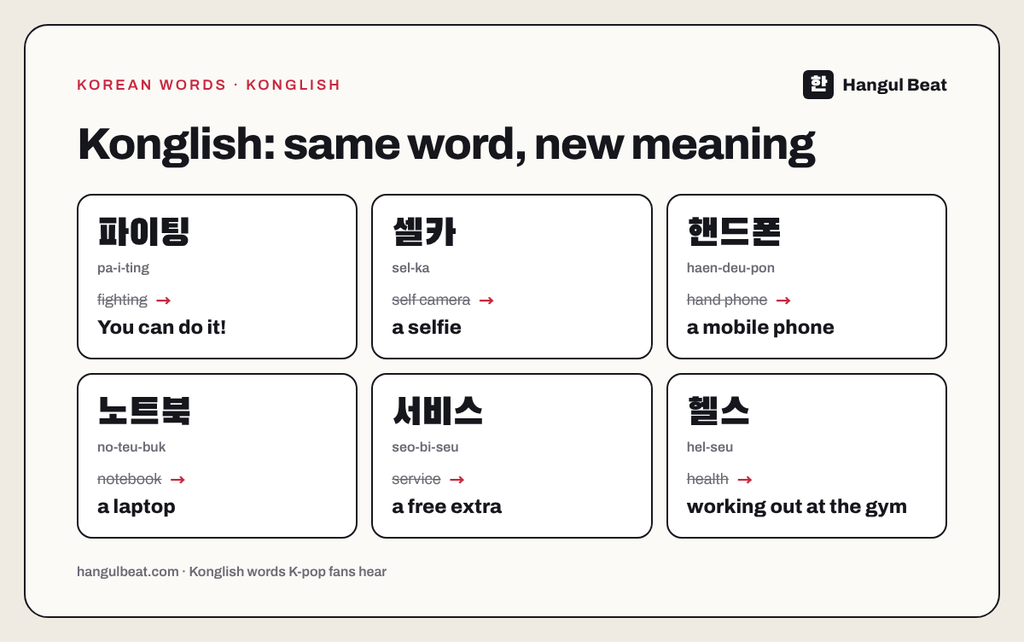
| 파이팅 | pa-i-ting | fighting | “You can do it!” or “Good luck!” |
| 셀카 | sel-ka | self + camera | A selfie |
| 핸드폰 | haen-deu-pon | hand phone | A mobile phone |
| 스킨십 | seu-kin-sip | skin + -ship | Friendly physical contact, like hugs or arm touches |
| 아이쇼핑 | a-i-syo-ping | eye shopping | Window shopping |
| 원샷 | won-syat | one shot | Drinking a whole glass at once, “bottoms up” |
| 컨셉 | keon-sep | concept | The theme, look and story of a comeback |
| 티저 | ti-jeo | teaser | Short photos or clips released before a comeback |
| 뮤비 | myu-bi | music video (short) | A music video, short for 뮤직비디오 |
| 포카 | po-ka | photo card (short) | The collectible member photo card inside an album |
| 팬싸 | paen-ssa | fan + sign | A fan signing event where you get your album signed and chat briefly |
| 엔딩 요정 | en-ding yo-jeong | ending + fairy | The member shown in close-up as a music show stage ends |
| 챌린지 | chael-lin-ji | challenge | A short dance clip of a song’s key move, shared on social media |
| 사인 | sa-in | sign | An autograph or signature |
| 서비스 | seo-bi-seu | service | Something extra a shop or restaurant gives you for free |
| 노트북 | no-teu-buk | notebook | A laptop computer, not a paper notebook |
| 헬스 | hel-seu | health | Working out at the gym |
| 원룸 | won-rum | one room | A studio apartment |
| 개그맨 | gae-geu-maen | gag + man | A comedian, the kind you see on variety shows |
A Closer Look at the K-pop Favorites
컴백 (comeback). In English, a comeback means returning after a long break. In K-pop, any new release with promotions is a comeback, even if the last one was just a few months ago. “When’s the next 컴백?” is one of the most-asked questions in any fandom.
비주얼 (visual). Many groups have a member fans call the “visual.” It’s a compliment, but also a role, like “main vocal” or “main dancer.”
파이팅 (fighting). This has nothing to do with fights. It’s a cheer you shout before an exam, a match or a stage. You’ll also see it spelled 화이팅 (hwa-i-ting), which is where the romanization “hwaiting” comes from.
직캠 (fancam). This one mixes Korean and English: 직접 (jik-jeop) means “directly” or “in person,” and 캠 is “cam.” Originally it meant a video fans filmed themselves; today it’s also used for official videos focused on one member.
올킬 (all-kill). When a new song reaches No. 1 on every major Korean music chart at the same time, fans call it an 올킬. It’s one of the biggest wins a K-pop release can get, and fans celebrate it loudly online. Fans often share chart screenshots the moment it happens.
컨셉 (concept). Every comeback has a 컨셉: the theme that ties together the outfits, photos, music video and stage. A group might go from a bright summer 컨셉 to a dark, edgy one in the same year, and fans debate which 컨셉 suits them best. The standard Korean spelling is 콘셉트, but you’ll see 컨셉 almost everywhere online.
엔딩 요정 (ending fairy). On weekly music shows, the camera zooms in on one member as the performance ends, while they hold a pose and catch their breath. Fans call that member the 엔딩 요정, the “ending fairy,” and the best ending fairy moments go viral as clips and screenshots.
포카 (photo card). Most K-pop albums come with a random member photo card, shortened to 포카. Fans trade them to collect their favorite member, which is why you’ll see “포카 교환” (photo card trade) posts all over fan communities.
Everyday Konglish You’ll Hear on Variety Shows
The last few words in the table aren’t fandom words, but idols use them constantly on variety shows and vlogs. If an idol says they went to 헬스 after practice, they mean the gym. If a restaurant owner gives them a free side dish as 서비스, it’s a small gift, not “service” in the English sense. And if a member opens a 노트북, it’s a laptop, not a paper notebook. These are the words that confuse English subtitles the most, so they’re worth learning early.
Pronunciation Tips
- Say every syllable. Korean adds vowels English drops, so “goods” is two beats, 굿-즈 (gut-jeu), and “hand phone” is four, 핸-드-폰 (haen-deu-pon).
- Turn “f” into “p.” Korean uses ㅍ for both, so “fighting” starts with a breathy “p”: 파이팅.
- Watch the ㅡ vowel. Endings like -드 and -즈 use ㅡ (eu), a flat-lipped sound. Our guide on how to pronounce Korean vowels shows exactly how.
Looking for native Korean words instead? Start with our list of 15 Korean words for K-pop fans.
My Take: Konglish Is a Bridge, Not a Mistake
As a Korean, I use Konglish every day without even noticing. I charge my 핸드폰, my friends go to 헬스 after work, and a good restaurant always gives a little 서비스. Most Koreans don’t think of these as English at all. They’re simply Korean words that happen to have an English past.
My own work makes this even clearer. I’ve spent about 20 years planning concerts and events in Korea, and backstage talk is full of borrowed words: 리허설 (rehearsal), 큐시트 (cue sheet), 셋리스트 (setlist). A crew can run a whole show in Korean while using dozens of words that started in English, each said the Korean way.
That’s why I tell K-pop fans that Konglish is the friendliest door into Korean. You already know half of every word. The only trap is assuming the meaning is the same as in English. When a Korean word looks familiar, enjoy the head start, then check how Koreans actually use it. That one habit will save you from most of the funny misunderstandings, like expecting a notebook and getting a laptop.
Konglish FAQ
What are Konglish words?
Konglish words are words that come from English but are used inside Korean, often with a new meaning or a shortened form. They are written in Hangul and pronounced the Korean way, like 셀카 for a selfie or 컴백 for a new release.
Is Konglish just broken English?
No. Konglish words are part of everyday Korean vocabulary. Koreans use them with each other, not to speak English, so they follow Korean sounds and Korean meanings. It’s similar to how English borrowed words like “karaoke” or “tsunami” and uses them its own way.
Why do Koreans say “fighting”?
파이팅 (or 화이팅) is a cheer that means “You can do it!” or “Good luck!” It came from English but has nothing to do with fighting in Korean. You’ll hear idols say it before a stage and fans shout it to support them.
Will English speakers understand Konglish words?
Sometimes not. Words like 원샷, 핸드폰 or 아이쇼핑 make sense to Koreans but can confuse people outside Korea. Use them with Korean friends and other K-pop fans, and use the standard English word when you’re talking to everyone else.
Final Thoughts
Konglish words are a shortcut into Korean: you already know half of each word. Learn the Korean meaning and the Korean pronunciation, and you’ll understand a big chunk of K-pop fan talk right away.
Which Konglish word surprised you the most? Tell us in the comments!
Sources: Konglish – Wikipedia · Sports Kyunghyang: LE SSERAFIM brings the K-pop ending fairy to TV