Aegyo Meaning: 애교, the Korean Art of Being Cute
What is the aegyo meaning? 애교 (aegyo) is the Korean word for acting cute on purpose: a softer, baby-like voice, a pout, a finger heart, a little wiggle. Koreans use it to show affection to the people they’re close to, and K-pop idols are asked to perform it so often that fans around the world now know the word.
But aegyo isn’t just “being cute.” It has its own sounds, its own phrases and even a bit of debate around it. In this guide, we’ll explain what 애교 means, how Koreans use it in everyday speech, where you’ll see it in K-pop, and how to say it.
What Does 애교 Mean?
애교 (aegyo, 愛嬌) combines 愛, “love,” and 嬌, “charming” or “delicate.” Put together, it’s a deliberately sweet, childlike way of talking and acting that says, “I like you, be nice to me.”
Aegyo usually shows up in three ways:
- The voice. Words get softer and higher, often with a rising-and-falling tone. Endings change too: the polite 요 (yo) can turn into 여 (yeo) or 용 (yong), so 고마워요 (thank you) becomes something like 고마워용.
- The face. Puffed cheeks, a pout, wide eyes, a quick wink.
- The hands. Finger hearts, cheek hearts, fists under the chin, little waves.
It’s important to know who aegyo is for. People use it with partners, close friends, parents and grandparents, not with a boss or a stranger. Used in the right place, it’s a way of being playful and close. Used in the wrong place, it can feel awkward.
How Koreans Use 애교 in Everyday Speech
| Korean | Romanization | Meaning |
|---|---|---|
| 애교 부리다 | ae-gyo bu-ri-da | to act cute, to turn on the charm |
| 애교가 많다 | ae-gyo-ga man-ta | to be naturally full of aegyo |
| 애교쟁이 | ae-gyo-jaeng-i | someone who’s always cute and playful |
| 애교살 | ae-gyo-sal | the small puffy line under the eyes, seen as youthful |
| 무뚝뚝하다 | mu-ttuk-ttuk-ha-da | blunt, not expressive: the opposite of aegyo |
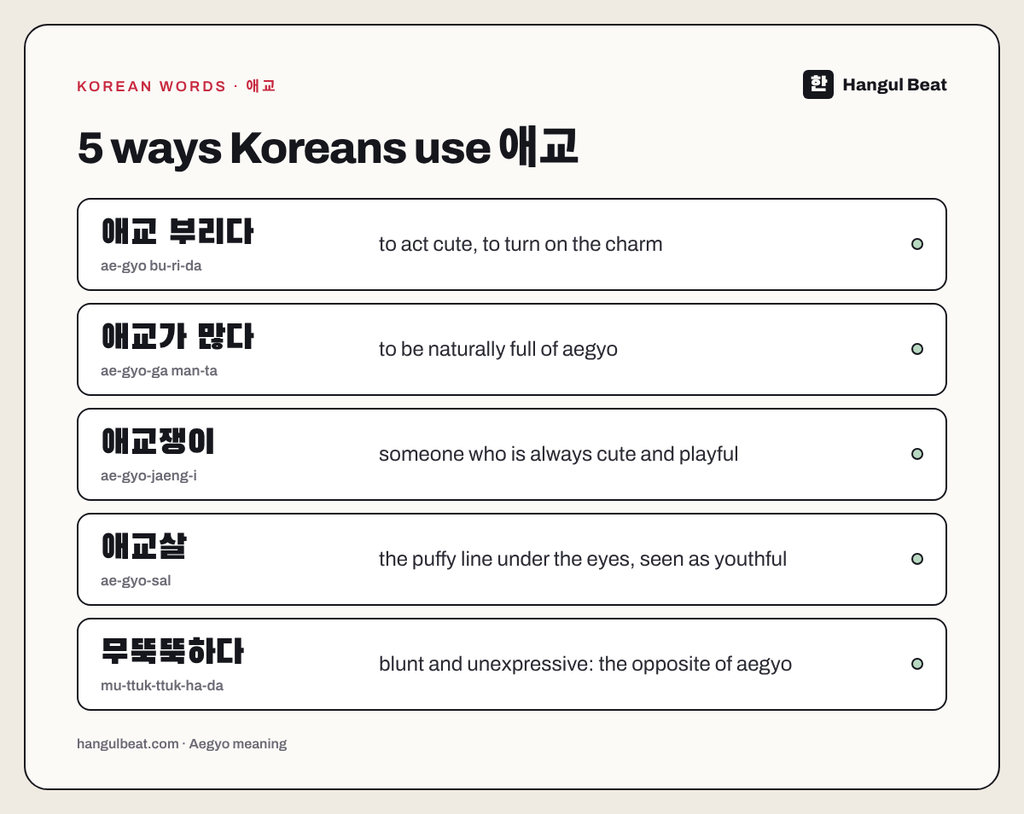
애교 부리다 is the phrase you’ll hear most. A younger sibling might 애교 부리다 to get a parent to say yes, and a partner might do it to end a small argument. It’s often said with a smile: “Stop it, you’re doing aegyo again!”
애교살 surprises many learners. It’s not a behavior at all, but the soft fold of skin just under the eyes that shows when you smile. In Korea, it’s considered cute and youthful, and there’s even makeup to make it stand out.
And 무뚝뚝하다 is a useful word to know alongside it. A 무뚝뚝한 person keeps their feelings to themselves. On variety shows, the funniest moments often come when a 무뚝뚝한 member is pushed into doing aegyo.

Aegyo in K-pop
If you watch K-pop content, you’ve seen aegyo. Idols of every gender are regularly asked to do it on variety shows, at fan meetings and during live streams. A common moment goes like this: the MC says “애교 해 주세요!” (please do aegyo!), the idol hides their face for a second, then gives the crowd a quick, exaggerated cute pose while everyone screams.
Some idols are famous for being natural 애교쟁이. Others are famous for being terrible at it, and fans love that just as much. Watching a tough-looking rapper try a baby voice is a whole genre of K-pop clip.
Aegyo even became a song. In 2013, singer Hari’s 귀여미송 (“Gwiyomi Song”) turned a simple counting rhyme with cute hand gestures into a viral challenge that idols and fans across Asia copied. 귀여미 (gwi-yeo-mi) itself is slang for “cutie.”
Is Aegyo Always Welcome?
Not always, and it’s worth knowing why. Researchers who study aegyo point out that it’s expected far more often from women than from men, and that some women feel pressure to perform it. Idols, too, sometimes admit they find on-the-spot aegyo requests embarrassing.
So think of aegyo the way Koreans do: it’s fun and affectionate between people who are close, but it works best when it’s offered, not demanded.
My Take: Aegyo From the Side of the Stage
I’ve spent about 20 years planning concerts and live events in Korea, and few moments get a louder reaction than an aegyo request. You can feel the whole room lean forward. What’s interesting from the side of the stage is that the crowd doesn’t actually need the aegyo to be good. They cheer just as hard for an artist who gets shy and laughs as for one who does it perfectly.
That tells me something about what aegyo really is. It isn’t about looking cute. It’s about letting your guard down in front of people who like you. When an idol does aegyo, they’re saying “I trust you enough to be a little silly here.” That’s why it lands best in small, warm moments, and why forcing it rarely works.
If you’re learning Korean, my advice is to recognize aegyo before you try it. Notice when friends or characters switch into that softer voice, and who they do it with. Once you can hear it, you’ll understand a lot about how close two people are.
How to Pronounce 애교
- 애 sounds like the “e” in “bed.” Open your mouth a little wider than for an English “e.” Our Korean vowels guide explains ㅐ.
- 교 is “gyo.” The ㄱ is soft, close to a light “g,” and ㅛ glides like the “yo” in “yo-yo.”
- Keep it even: ae-gyo, two short syllables with no strong stress.
Aegyo FAQ
What does aegyo mean in Korean?
애교 means acting cute on purpose, through a softer voice, cute expressions and gestures. Koreans use it to show affection to people they’re close to.
Do Korean men do aegyo too?
Yes. Male K-pop idols are asked to do aegyo just as often as female idols, and men use it with partners and family as well. In everyday life, though, it’s still expected more often from women.
What is aegyo-sal?
애교살 (aegyo-sal) is the small puffy fold under the eyes that appears when you smile. In Korea, it’s seen as youthful and charming.
Is it rude to ask a Korean person to do aegyo?
It depends on the relationship. Between close friends it’s playful, but asking someone you don’t know well can make them uncomfortable. When in doubt, don’t ask.
Final Thoughts
애교 is more than a cute voice. It’s a small, playful way Koreans show closeness and trust, and once you can hear it, you’ll notice it everywhere, from dramas to fan meetings to family dinners. Just remember: the best aegyo is the kind that’s given freely.
Who do you think has the best aegyo in K-pop? Tell us in the comments!
Keep Reading
- 정 (jeong) meaning: the Korean word for the bond that grows over time
- 흥 (heung) meaning: the joy that makes you move
- Korean honorifics for K-pop fans
- 15 Korean words every K-pop fan should know
Sources: Aegyo – Wikipedia