How to Pronounce Korean Vowels: ㅓ vs ㅗ and Other Tricky Sounds
If you want to sing along to K-pop or say a few words to Korean friends, learning how to pronounce Korean vowels is the best place to start. Get the vowels right and even simple words suddenly sound natural.
The good news: Korean vowels are very regular. Each letter makes one sound, almost every time. The tricky part is that a few of them don’t exist in English, and romanization often points you to the wrong sound.
Why Romanization Can Trick You
Romanization is a helpful bridge, but it uses English letters for sounds English doesn’t have. That’s why you see odd spellings like “eo” and “eu.”
Take the capital of Korea. It’s written “Seoul,” so many people say “soul.” But in Korean, 서울 has two syllables and sounds closer to “Suh-ool.” Once you know the real vowel behind “eo,” you’ll never say it the old way again.
The Basic Korean Vowels
Here are the eight basic vowel sounds. The English hints are close, not perfect, so use them as a starting point.
| Vowel | Romanization | Sounds like | Example word |
|---|---|---|---|
| ㅏ | a | the “a” in “father” | 사랑 (sa-rang), love |
| ㅓ | eo | the “u” in “but,” mouth open | 너 (neo), you |
| ㅗ | o | “o” in “go,” short, lips round | 오빠 (o-ppa) |
| ㅜ | u | the “oo” in “moon” | 우리 (u-ri), we |
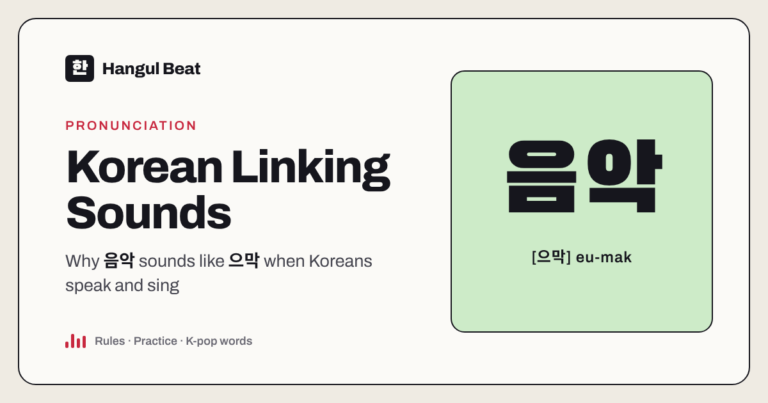
| ㅡ | eu | no English match: “oo” with flat, smiling lips | 음악 (eu-mak), music |
| ㅣ | i | the “ee” in “see” | 이름 (i-reum), name |
| ㅐ | ae | the “e” in “bed” | 대박 (dae-bak) |
| ㅔ | e | the “e” in “bed” (same today) | 네 (ne), yes |
The Tricky Pairs
Most learners only struggle with a few vowels. Here’s how to tell them apart.
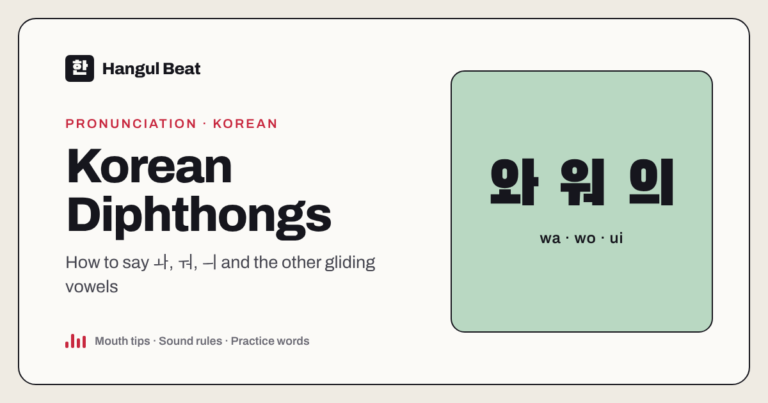
ㅓ (eo) vs ㅗ (o)
This is the pair that trips up almost everyone, because both are often heard as “o” by English speakers.
- ㅓ (eo): Open your mouth fairly wide and keep your lips relaxed, not rounded. It’s close to the “u” in “but” or “up.”
- ㅗ (o): Round your lips into a small circle, like you’re about to whistle. It’s a short, clean “o” with no “w” glide at the end.
Mirror test: Say 어 (eo), then 오 (o). If your lips don’t change shape, you’re saying the same sound twice. For 오, your lips should push forward into a circle.
Practice: 너 (neo, you) vs 노래 (no-rae, song). 언니 (eon-ni, older sister) vs 오빠 (o-ppa, older brother).
ㅡ (eu) vs ㅜ (u)
The ㅡ sound doesn’t exist in English, so most people turn it into “oo.” The difference is all in the lips.
- ㅜ (u): Round your lips and push them forward, like the “oo” in “moon.”
- ㅡ (eu): Keep your tongue in the same place, but spread your lips flat, as if you’re smiling a little. The sound comes from the back of your mouth.
Smile trick: Say “oo,” then slowly smile while keeping the sound going. The moment your lips go flat, you’ve found ㅡ.
Practice: 우리 (u-ri, we) vs 음악 (eu-mak, music). 그리움 (geu-ri-um, longing) uses both: flat ㅡ first, then round ㅜ.
ㅐ (ae) vs ㅔ (e)
Here’s some good news. In modern Seoul Korean, most people pronounce ㅐ and ㅔ the same way, like the “e” in “bed.” Koreans tell words like 개 (gae, dog) and 게 (ge, crab) apart by context, and sometimes even they have to ask how a word is spelled.
So don’t worry about these two when speaking. Just learn the correct spelling for each word when you write it.
Practice With Words You Already Know
The easiest way to practice is with words you’ve heard many times in K-pop and K-dramas. Say each one slowly, then at normal speed.
| Word | Romanization | Meaning | Vowel to watch |
|---|---|---|---|
| 서울 | seo-ul | Seoul | ㅓ open, then ㅜ round |
| 너 | neo | you | ㅓ, not “no” |
| 노래 | no-rae | song | ㅗ with round lips |
| 오빠 | o-ppa | older brother | ㅗ, short and clean |
| 언니 | eon-ni | older sister | ㅓ, not “on” |
| 음악 | eu-mak | music | flat-lipped ㅡ |
| 그리움 | geu-ri-um | longing | ㅡ first, ㅜ later |
| 꿈 | kkum | dream | round ㅜ |
Want to learn what these words mean and how Koreans use them? See our guide to 15 Korean words every K-pop fan should know.
A Simple 5-Minute Routine
- Say the eight basic vowels in a row: 아, 어, 오, 우, 으, 이, 애, 에.
- Practice the tricky pairs in front of a mirror and watch your lips.
- Read the practice words above out loud.
- Record yourself on your phone and compare with a Korean speaker in a video or song.
- Repeat a few days in a row. Small daily practice beats one long session.
Final Thoughts
You don’t need perfect pronunciation to enjoy K-pop, but getting the vowels right makes a big difference. Once ㅓ and ㅗ feel different in your mouth, you’ll start hearing the difference in every song.
Which Korean sound is the hardest for you? Tell us in the comments!